
Here’s the swimmer’s guide to swim fins: when to use them, how to pick out a pair that matches your goals in the water, and reviews of some the best swim fins available.
Training with fins is simply the best.
You get to experience speeds that your heroes swim at (or faster). Being able to power through the water at a velocity that you can only dream about doing with regular swimming is intoxicating, and a top reason why we all scramble for them the moment coach scrawls “w. fins” on the whiteboard.
But training with swim fins is more than just going really, really fast.
It can also help us become better swimmers without fins, improve ankle flexibility, and strengthen the weakest part of our kick—the upkick.
In this guide to training with swim fins, we are going to cover a whole bunch of stuff, like:
- The pros and cons of swimming with fins
- The research showing what happens when we kick with fins on;
- The reasons they can be so effective at helping us become better swimmers;
- The potential pitfalls of relying on them too much
Let’s do this!
Looking for the right set of fins for training and improving your swimming? Read our complete guide on choosing the best swim fins.
The Effects of Training with Fins
You already know the general effect of strapping the equivalent of a jetpack to your feet:
You go absurdly fast.
Grant Hackett and Michael Phelps, when engaging in a week of going head-to-head in training strapped on fins at the end of a practice and swam :21 seconds low for a 50m free. Long course.
Beyond going quick, according to some research (and our experience) using fins in practice does the following:
- They drastically lowered kick frequency, an average of 40%.
- There is also a decrease in work expenditure, with reduced energy cost of 40% at comparable swimming speeds (meaning you can match your top swimming speeds with much less effort).
Swim Fins: The Benefits
Alrighty, let’s start off with the benefits of swimming with fins:
1. They can help ease the pounding that your shoulders take every day at practice.
One of my favorite pieces of advice I got from a coach was to use fins during warm-up. Strapping them on at the beginning of the workout helped avoid some unnecessary strain on those all-important shoulders.
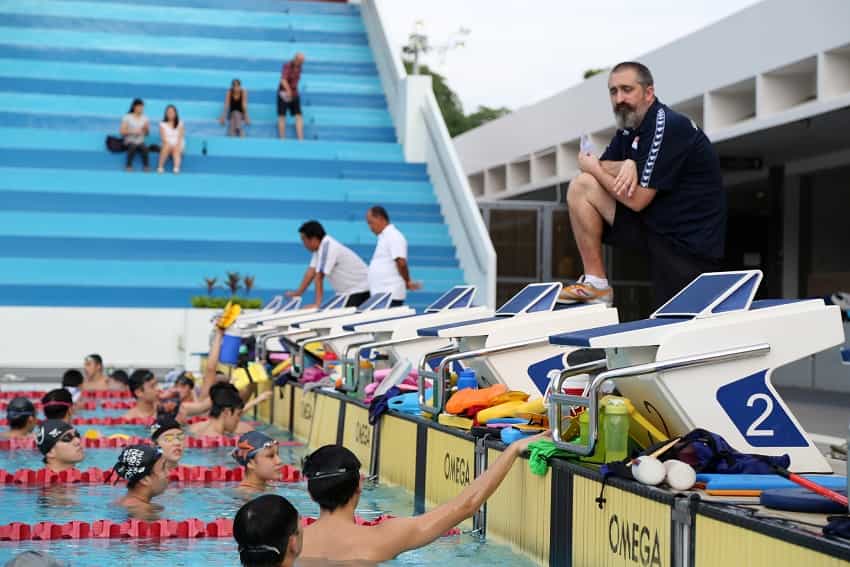
Whenever I was fighting off a fresh case of swimmers shoulder during my late teenage and university years I was often instructed to strap on the fins to help ease the strain on my upper body.
This ranged from swimming with fins to doing straight kick, but the premise was simple—remove the load from the shoulders and onto the hips and legs.
Fins can be a great training aid for when your upper body is either injured, or you want to ease into your swim workout.
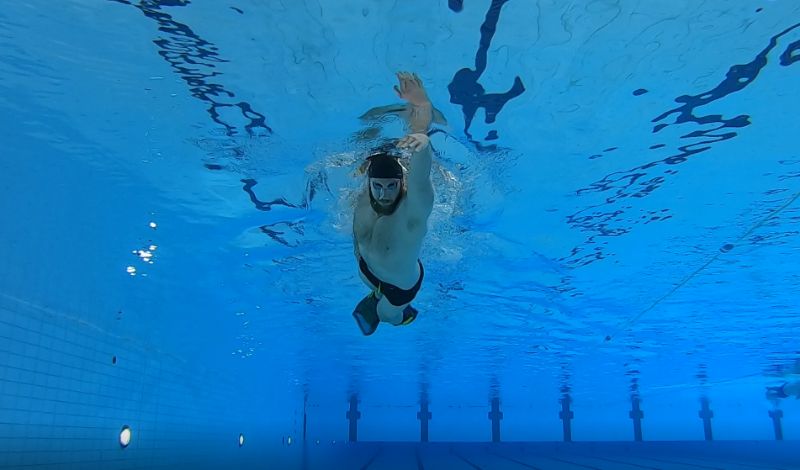
2. Increases overall strength and endurance in your legs.
Fins are tools of resistance. Your legs contain the biggest muscles in your body–that added work means that they are getting a harder workout, something that is perfect for increasing overall power and conditioning.
If you wanna go next level with your power and strength work combine your fins with a pair DragSox. It gives you a strange mix of added speed and resistance at the same time compared to your regular kicking speed. Your legs won’t know what hit them.
And lastly, for swimmers who prefer to dangle their legs limply behind them like kelp as they swim along, fins generally help boost the cardio/aerobic nature of their work. Not kicking when you have fins on your feet generally leads them to sinking, so by nature of maintaining any kind of forward propulsion, you have to kick.
3. Easier to hit the upkick.
Our coaches are always telling us to work on the upwards phase of our kick, but it can often feel a little weird. We’ve become so accustomed to kicking downwards—which is a much more natural kicking motion—than kicking up, which leaves us feeling disjointed and awkward.
The added surface area of fins helps you really feel out the up-kick.
If you really want to work on your up-kick throw some vertical kicking into your practices—you’ll come to appreciate how important it is when kicking vertically, especially with dolphin kick.
4. Uh, using them is really fun?
Swimming with fins is fast and fun. Flying under and across the water, whether dolphin kicking or swimming, at lightspeed is quite pleasurable.
The speeds we attain are higher, the wakes we create are massive (sorry-not-sorry swimmers in the next lane!), and we get to swim at paces we rarely are able to when straight swimming.
Simple as that.
5. They help improve ankle flexibility.
The importance of ankle flexibility for swimmers is hard to overstate, and is one the most important factors in having a deadly kick. A low range of motion in your feet means that you are kicking water downwards, as opposed to kicking water backwards.
A reason a lot of triathletes and newbie swimmers have such horrendous kick is because they have next to no range of motion in their ankles.
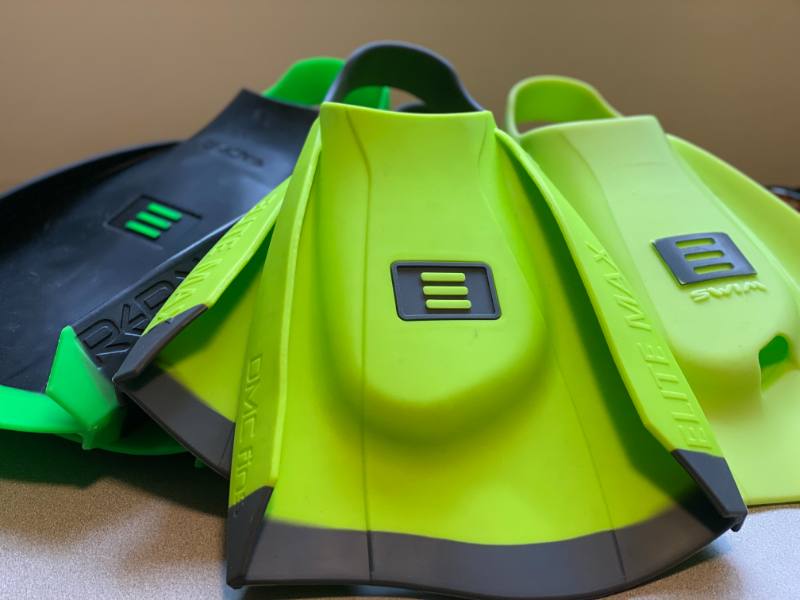
When we are wearing fins you come to understand this—the extra surface area extending to the tip of them provides additional ankle extension and surface area to plant into the water to push you forward.
Fins put your feet into a position where your ankles are largely forced to be pointed/extend, which will help improve overall flexibility in your feet.
6. Improved body position.
If you are using the fins to kick, and not simply dangle behind you, your body will ride higher in the water. It gives you that amazing feeling of skimming across the surface of the pool.
This effect is especially noticed in swimmer’s whose kick isn’t very strong, and therefore tend to sag and bulldoze their way through the water.
Fin-powered swimming shows you the body position you want to attain during your regular swimming and reminds you how crucial it is to work on your kick.
Swim Fins: The Downsides
1. They can become a crutch.
The swimmers who scramble for fins the fastest are usually the ones with the worst kicks. They become dependent on the tool, and can hide their shoddy ankle flexibility behind the raw quad and hamstring power we rely on with fins.
You will never catch up to your fast-kicking teammates by always reaching for the fins every time a kick set comes up.
2. You can’t use them during meet warm-ups.
Every competition warm-up I’ve ever experienced or been on deck for, from summer league to Trials to masters meets, don’t allow their use during warm-ups. Which makes sense. Meet warm-up is already a nightmare, last thing we need is people zipping back and forth with flippers.
Don’t make your pre-competition ritual reliant on them whatsoever unless you are planning on sneaking off to the corner of the dive tank to do some vertical kicking.
3. Blisters.
I’ve gone through dozens of pairs of fins over the years, and some of them have left some truly unsightly blisters on my feet.
Not fun.
The first time I used DragSox and fins at the same time I walked off of the pool deck with a set of blisters that made it look like I had spent an afternoon dolphin kicking the bottom of the pool.
Case in point:
The Takeaway
While swimming with fins is fun, remember that they are simply another tool in your arsenal.
Think beyond just getting to swim fast when you wear them.
Use your swim fins to help improve ankle flexibility, develop a more balanced kick, fix your body positioning in the water, and of course, drown the swimmers in the next lane with your massive wake.
How to Develop an Unstoppable Freestyle Kick. Ready to develop a legendary flutter kick? Here is everything you need to know to get kickin’.
The Monofin: Your Weapon for a Killer Dolphin Kick. Want to level up your underwaters? Learn how a Monofin is one of the most potent weapons for taking your fly kick to the next level.