
Looking to let more speed fly in the pool? Here’s several common myths when it comes to developing top-end freestyle speed in the water.
Raise your hands if you like going really, really fast in the pool, and you want to go even faster?
Everyone? Alrighty!
The easy answer to faster sprinting is usually “sprint more” or “try harder ya silly pants!”
The truth is that sprint freestyle looks straightforward, but in reality, it comes down to training smart, training with the right technique, training with the right tools, and training sprint-style consistently.
Below, we’ll break down six of the most common myths about developing sprint freestyle speed so that you can hit the water each day with confidence that you’ll have the nitro you need on race day.
This article on sprint freestyle mistakes is part of our series of guides for improving sprint freestyle performance. Read more of our guides below.
“Sprint technique is the same as regular freestyle.”
Sprint freestyle technique and kinematics are drastically different than “regular” freestyle. It’s even much different than the technique/kinematics seen in the next shortest freestyle event, the 100 free.
Sprint freestylers use different:
- Tempo – Sprinters use the highest stroke rate in the pool, and it’s not even close. For example, finalists in the 50 free at the Paris Olympics used a stroke tempo of 60-65. Compare that to the finalists in the 100 free (~50) and 200 free (40-45). Big difference!
- Stroke coordination – At maximal speeds, swimmers use significant overlap in the strokes (as measured by something called “Index of Coordination”). At submaximal speeds, swimmers use a slight to moderate gallop (Seifert and Bardy (2004).
- Body roll. Sprinters use the same shoulder roll range as regular freestyle, but roll the shoulders at much higher velocities, combined with flatter hips to create a more powerful twist in the torso for explosive arm strokes.
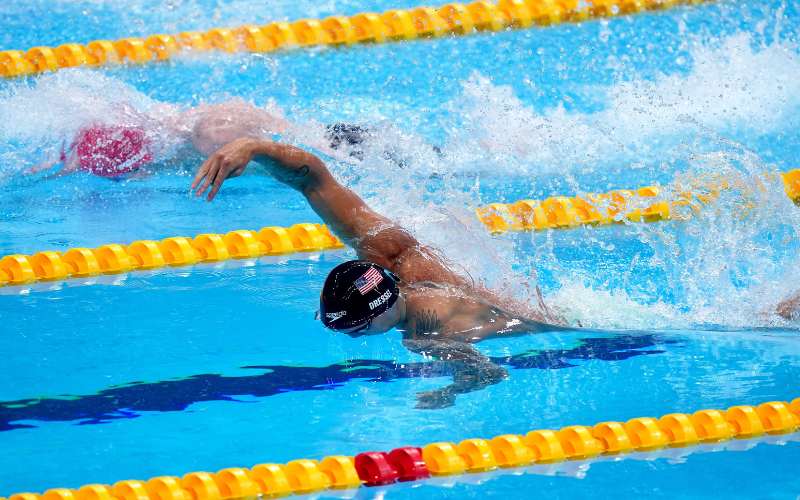
Even the kick differs, with sprinters using a narrower, super-high-frequency kick with less roll.
To sprint fast, train sprint mechanics. Sprint freestyle isn’t regular freestyle done with more intensity.
“Go max effort every rep.”
Sprinters live at the edge of effort. All out, all the time. That’s the sprinter’s life.
But being a little smarter about prescribing effort levels can increase power without burning out and crashing, or worse, injuring yourself.
One cool study (Gonzalez-Rave et al, 2018) compared two resisted sprint sets with swimmers:
- Standard sprint set (every rep at 70% of 1RM)
- Pyramid sprint set (progressing from 50 to 70 to 50% of 1RM)
Even though the pyramid design had fewer all-out yards, it produced greater improvements in power. Researchers chalked it up to extra variation in load, giving swimmers more opportunities for neuromuscular adaptation.
Here’s how the sets looked:
| Standard | Pyramid | |
| Rep 1 | 12.5m @ 70% of 1RM | 12.5m @ 50% of 1RM |
| Rep 2 | 12.5m @ 70% of 1RM | 12.5m @ 60% of 1RM |
| Rep 3 | 12.5m @ 70% of 1RM | 12.5m @ 70% of 1RM |
| Rep 4 | 12.5m @ 70% of 1RM | 12.5m @ 70% of 1RM |
| Rep 5 | 12.5m @ 70% of 1RM | 12.5m @ 60% of 1RM |
| Rep 6 | 12.5m @ 70% of 1RM | 12.5m @ 750% of 1RM |
Organizing load this way creates more neural gains while reducing the grind and crater of constant max efforts. Precision with intensity beats out endlessly smashing against the wall.
“Resisted sprinting is optional.”
Chutes, cords, power towers, and DragSox are essential for the sprint-focused swimmer. There are plenty of studies of swimmers showing the benefits of resisted swimming and seeing boosts in sprint speeds.
Resisted swimming tools can improve stroke rate, increase power in the stroke, and target the specific muscles actually used in sprinting.
One study even compared resisted to unresisted sprint training, and yup, you guessed it, the resisted sprint training group won out.
Some other sneaky benefits of resisted sprint training include:
- Hardening your race tempo – Target race tempo with light resistance to make it feel “easier” when sprinting unresisted.
- Improve body line – Resisted sprint training forces the body to self-organize in a way to be able to exert more power. Pay attention to these moments, as they reinforce a stronger catch, hands that accelerate under the body, and a more horizontal body position.
“Paddles and fins boost sprint speed.”
This section pains me to write, as fins and paddles are constantly whispering sweet nothings to me from my mesh bag when in the pool.
And there is certainly a place for them in your swim training, but they are quite limiting in terms of specificity for sprint training.
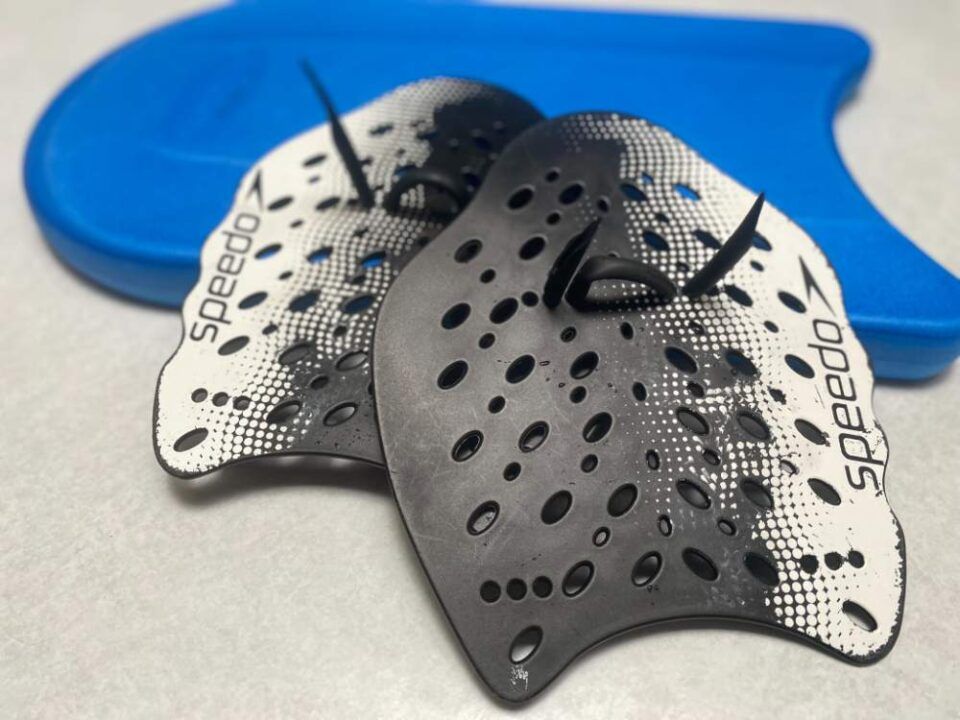
For example:
- Paddles increase pulling surface, but clamp down on stroke rate. You end up training a slower, loping stroke that lives outside of sprint tempos.
- Fins increase speeds, but change stroke kinematics. Sprinting with fins lengthens the stroke and increases the glide at the front of the stroke. Not very sprinty.
One study (Barbosa et al., 2013) with true sprint sets and paddles showed no measurable increase in swim velocity. Stroke rate and stroke length didn’t improve, either. Swim paddles, in this case, didn’t help sprint performance.
(Booo.)
Both tools have a role to play in your training—strength development, sharpening that catch technique, general leg endurance—but in terms of building peak sprint speed, sprint the way you are going to sprint on race day without the boosts.
“I can do all my strength and power work in the pool.”
The training that happens in the pool is always going to come first. Protect those high-quality yards and meters. But you can strengthen and power up those movements with the right dryland training.
Things like:
- Jumping rope – Stronger ankles, faster foot positioning when kicking, more explosive reactions on starts and turns. Everything a growing sprinter needs!
- Strength training – Classic exercises like bench presses and squats have shown strong correlations to sprint swimming performance (Keiner et al., 2021).
- Plyometrics – Faster, crisper turns and starts are fueled by the same explosive leg and hip drive seen in plyometric exercises. Jumping, bounding, exploding.
- Core training – The glue that holds it all together! The core doesn’t directly create power, but rather controls it, amplifying the strength and power work you are doing in the pool and in the gym.
Dryland training for swimmers is sometimes controversial, typically because it’s done in conjunction with high-volume aerobic training (creating competing adaptations) or because when used improperly can lead to injury.
But smart, targeted dryland workouts help you exert more power and force on the starting block, through your underwaters, and when sprinting to the other to a golden finish.
“I’ll wait until taper to work speed.”
One of the biggest boo-boos swimmers and coaches make is waiting until the last few weeks before competing to uncork speed.
The traditional periodization model (periodization is how training is organized and planned over time) breaks the season into three phases:
- General. Building a foundation of conditioning and technical skills. When people say they are “building a base” this is typically what they are referring to.
- Specific. Targeting race-specific energy systems and mechanics. Taking the base and turning it into building blocks of performance.
- Competitive. Sharpening performance for peak results. Where swimmers sometimes finally begin taking speed seriously.
The problem is that you follow this model and only sprint at the end you’re too late.
Haugen et al. (2019) reviewed the best practices of top track coaches and noted that many are skeptical of this model because the early focus on volume and later shift to intensity creates inappropriate early adaptations and results in too little actual sprint work.
Plus, dropping the hammer on the intensity so late in the training cycle can cause a spike in injury risk.
Swimmers can instead opt for a “short-to-long” model that starts with speed early and extends it across longer distances as the season unfolds.
Speed is the most precious thing in swimming. It is what it is all about. I do not understand why you would spend weeks and months not training speed, then hoping it will come back when you taper and race… train for speed all year round. Sprinters must sprint often and race regularly throughout the year. – Gennadi Touretski
Remember that neuromuscular adaptations like reaction time, the coordination to maintain high tempo stroke rate, and peak levels of kick frequency are slow-cooking skills.
They work best with a steady diet and not a crash course in the frantic final few days before racing.
The Bottom Line
Sprint training looks easy and simple. Strap on your favorite set of swim goggles, slug two scoops of high-octane pre-workout, and dive into the water and tear the water apart with fury and intensity.
Although short, sprint events are decided long before with smart planning, the right tools, and the right dryland.
Do your best to avoid the common myths and mistakes listed above, and you will be well on your way to hitting faster velocities and podium finishes.
Happy sprinting!