
Learn why stroke rate matters for sprint freestyle, what happens when you push past your natural maximum, and how to build the turnover that holds up on race day.
Stroke rate—how quickly the arms turn over—is one of the simplest concepts in sprint freestyle swimming.
More turnover = more speed. Simple enough.
But elite sprint freestyle isn’t just about spinning the arms faster. There are real constraints on how high stroke rate can go and what happens to your stroke when you push it there.
To master sprinting, the enterprising sprinter needs to understand those constraints.
Here’s why stroke rate is so important, how it changes your stroke, and how to get better at harnessing peak stroke rates on race day.
This article on stroke rate for sprint free is part of our series on improving sprint freestyle performance. Read more of the articles below.
Stroke Rate – The Tempo of Sprint Freestyle
Swimming velocity comes down to two variables: how far you travel per stroke (stroke length) and how many strokes you take per minute (stroke rate).
Stroke Rate x Stroke Length = Velocity (gold medals and personal best times).
That’s it. Really. Every training, technical, and tactical decision a sprint freestyle swimmer makes is ultimately an attempt to optimize that friendship.
You can go faster by covering more distance per stroke, by turning over faster, or the best case scenario—by doing both. The challenge is that these two variables tend to work against each other.
As stroke rate goes up, stroke length goes down. And vice versa.
What is Stroke Rate? Stroke rate is a metric that tells us how many strokes a swimmers takes per minute. It’s typically measured in stroke cycles per minute.
We’ll look at this relationship in more detail later, but for now, the focus is on stroke rate: what it is, what drives it, and why it matters.
Stroke rate has a strong record as a performance predictor. A meta-analysis by Ruiz-Navarro et al. (2025) found that stroke rate was positively associated with sprint performance. Generally, an elite 50 freestyle means swimmers have higher stroke rates than slower ones.
The Paris Olympics freestyle finalists give us a better sense of how high stroke rates is a key differentiating characteristic of sprint performance:
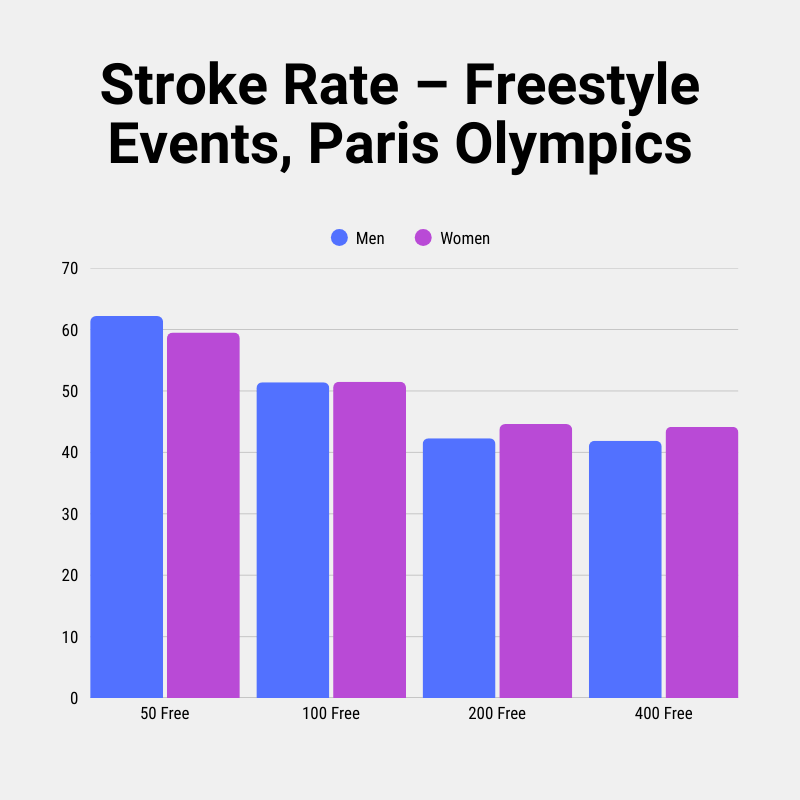
Both sexes saw sky-high stroke rates in the 50m freestyle, averaging around 60 cycles/minute. By the 400m, that number had dropped to 41.9—a reduction of nearly a third!
Even the 100 freestyle, often (and mistakenly) considered a sprint, has a much lower stroke rate than the 50 freestyle.
Stroke rate is a key part of sprint freestyle, not only because the increased turnover displaces more water, but because it also changes our stroke in ways that is better suited for sprinting.
Stroke Rate and Stroke Coordination
Sprint freestylers know that overlapping stroke coordination—where at least one hand is always generating propulsion—is the template for fast freestyle.
In contrast, catch-up timing has propulsive gaps where the swimmer is gliding rather than pulling. At sprint speeds, those gaps flatten any hopes swimmers have of increasing velocity.
And increasing stroke rate is what gets stroke coordination into sprint mode.
A study by Potdevin et al. (2006) examined a group of swimmers, half expert, the others not, and had them swim 25m freestyle trials with stroke rates ranging from 35 to 55 cycles/minute. At the lower stroke rates, swimmers all used a variation of catch-up.
But as stroke rate went up, swimmers responded by shifting more towards superposition timing, measured by Index of Coordination (IdC).
Index of Coordination (IoC) is a way to measure arm overlap during a freestyle stroke. Negative scores indicate catch-up timing, with a gap between when one arm finishes pulling and the other starts. Positive scores indicate superposition—both arms generating propulsion simultaneously.
The expert swimmers didn’t gradually drift toward superposition as stroke rate climbed. Instead they held deep in catch-up territory at lower rates—at 45 cycles per minute their coordination score was still -10.4%, more catch-up than the non-experts.
But then they made a sharp, decisive switch when stroke rate crossed 50. The non-experts crept gradually toward superposition but never fully arrived.
| Stroke Rate (cycles/min) | Non-Expert Group IdC (%) | Expert Group IdC (%) |
| 35 | -12 | -12 |
| 40 | -9 | -12 |
| 45 | -6 | -10.4 |
| 50 | -1 | -4 |
| 55 | -1.5 | 0.5 |
Seifert et al. (2007) found the same pattern across a wider range of paces. Below roughly 40 strokes per minute, all swimmers used catch-up. Above it, swimmers moved toward superposition.
And it was stroke rate that was the strongest predictor of that change—stronger than velocity, race pace, or stroke length.
At the elite end, only swimmers who broke 50 strokes per minute also broke 1.8 m/s. Above that speed, drag rises so sharply that overlapping propulsion becomes a mechanical necessity. Swimmers who couldn’t get their stroke rate there stayed in catch-up—and stayed slower.
Stroke rate isn’t just a fun metric to count arm rotations. It’s the lever that unlocks sprint coordination and the arm turnover required to sprint at elite speeds.
Stroke Rate and Stroke Length
Even though stroke rate dominates the look of the sprint freestyle technique, swimmers need stroke length, too.
Staunton et al. (2025) analyzed stroke rate and stroke length combos from 324 elite swimmers across all freestyle events at the 2019 European Short Course Championships.
In the 50m free, stroke length was actually the stronger predictor of speed while stroke rate showed trivial or even slightly negative associations with performance.
Swimmers who covered more distance with each stroke cycle tended to go faster.
Why the apparent contradiction? At the elite level, everyone has a high stroke rate. But not everyone can continue to exert force, hold water, and maintain technique under fatigue.
Stroke length is the harder variable to defend.
When a swimmer starts to tire, it’s stroke length that goes first—the catch shortens, the pull loses its anchor, and distance per stroke starts to shorten. Maintaining turnover is relatively easier than sustaining the force required for a long stroke at sprint speeds.
Morais et al. (2022) confirmed this from a different angle. Across 38 youth swimmers, the fastest swims weren’t from the swimmer with the highest stroke rate or the longest stroke, but from who had an optimal combination of both.
Elite sprinters don’t try to max out on either variable, but instead focus on raising the stroke rate at which they can still hold a significant amount of stroke length.
Stroke Rate Max (and Beyond)
High stroke rates mean faster times, so why not crank it to the absolute max?
If only it worked that way! Each swimmer has a natural stroke rate ceiling, and for most, pushing beyond it doesn’t produce more speed.
A study by Koga et al. (2020) looked at what happens when swimmers performed 20m freestyle sprints at their maximal stroke rate, and then at 110% and 120% of that maximum.
What’s an elite stroke rate for freestyle sprinters? The fastest 50 freestylers on the planet use a stroke rate between 55 and 65 cycles per minute. At the 2024 Paris Olympics, men’s 50m freestyle finalists averaged 62.2 cycles per minute and women’s averaged 59.5.
When swimmers revved beyond their natural max, speed didn’t improve.
Why? Once we overclock tempo, some of our mechanics start to fall apart. When the stroke rate was pushed to 120% of maximum:
- Angle of attack in the push phase collapsed by nearly 26%
- Palm pressure dropped
- Propulsive force tumbled.
Essentially, swimmers sliced their hands through the water instead of holding and pulling themselves through it.
The 110% condition was a little more interesting. On average, the group’s speed didn’t change, but three of the eight swimmers did swim faster at this SR level. What they thought was their natural max was short of the actual ceiling.
Practicing at stroke rates above your perceived maximum—with the specific goal of maintaining hand angles and displacing water backwards through the push phase—is how you find out whether your ceiling is real or just habitual.
How Sprint Freestylers Can Improve Stroke Rate
Understanding stroke rate is one thing, but we are here to get better and sprint faster, so let’s train it. Here are some practical tips for how sprinters can fine tune stroke rate.
Find your ceiling
Look at your past 50 freestyle swims—what was your stroke rate in those races? This gives us a baseline to train and test again.
Do targeted tempo sprints of 15-20m at slightly higher than race-pace tempos to see if that is your natural ceiling, or if you’d benefit from targeting a higher tempo.
We aren’t trying to go 120% of max, but flirting with 105-110% to see what the max truly is.
Build stroke rate in chunks
Holding 50 freestyle stroke rate for long distances in the pool is not sustainable. Instead, build up the distance incrementally—15m, then 20m, 25m, 30m.
This type of sprint set accumulates tempo-specific meters and lets you get comfortable at higher rates without the chlorinated wheels flying off. Load up the tempo trainer with your target race pace and stack reps.
Resisted swimming
Reach into your mesh bag and grab your drag chute, resistance tubing, power tower.
Resisted swimming supports higher stroke rates, both in terms of increasing force in the pull and promoting the stroke timing that naturally leads to higher stroke rates.
Amara et al. (2021) paired dryland upper body work and resisted swimming and saw significant improvements in stroke rate and swim velocity.
Train velocity in the gym, not just load
Ruiz-Navarro et al. (2025) found that movement velocity in dryland correlated better with swim performance than slow, heavy lifting.
Explosive pulling movements—fast paced pull-ups, med ball throws, fast lat pulldowns—give you the raw materials to train the nervous system for faster turnover in the water.
Banded pull work
Pulling with a band around the ankles removes the legs from the equation, making it less metabolically demanding and letting you focus entirely on upper body tempo and power.
Use it to hold target stroke rates for longer than you could in full swimming.
The Sprinter’s Stroke Rate
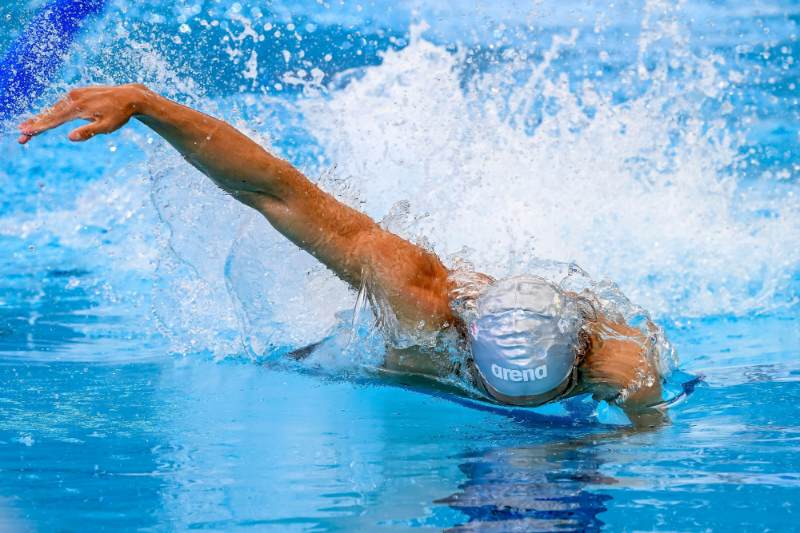
Stroke rate is the most visible characteristic of sprint freestyle. The windmilling arms crashing into the water, cycling thunderously as swimmers rip across the pool.
But pure, raw turnover isn’t just spinning the arms mindlessly.
Elite sprinters lock onto a stroke rate that allows them to displace tons of water and below where technique starts to collapse. Then they’ve built the strength, neuromuscular capacity, and race-specific tempo conditioning to sustain it when it matters.
That’s the goal. Not maximum stroke rate, but the optimal stroke rate for speed.
Find your natural max, build the power to hold length, and the medals and times will take care of themselves.
Happy sprinting!